
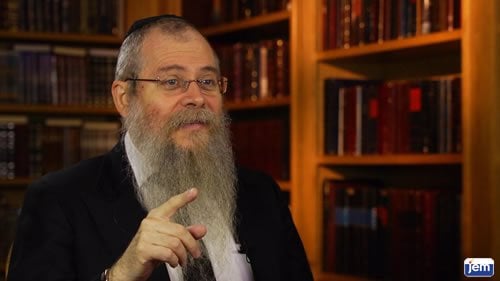
When my friend Rabbi Daniel Moscowitz, now the Chabad emissary in Illinois, and I were young students in yeshivah, we volunteered for Merkos Shlichus—the Chabad Jewish outreach program by rabbinical students. In the summer of 1976, we were presented with an opportunity to go on a short trip to Sweden. We prepared everything that was needed, and we went to Sweden for about ten days or two weeks. We visited a few small towns, but mainly we stayed in the capital, Stockholm. We gave classes in the local synagogues, and we distributed mezuzahs and tefillin.
While there, we were told that about two hours from Stockholm was a very small town, by the name of Västerås, where a few Jewish families were living. So, we decided to visit them.
The Jews in this town were not religious, except for one man. I remember his name was Gilinderman. He told us that his family had made aliyah to Israel in 1948, and for a time he had even learned in the Lubavitcher yeshivah in Kfar Chabad, Israel. Then his family went back home to Europe, and he ended up marrying a Jewish woman from this small Swedish town, and settled there.
We were astonished by his story, and we spent some time with him. He told us about his life in this town. He said he was alone there in trying to keep Torah and mitzvahs. He put on tefillin, and he would not eat unkosher meat. He slaughtered his own chickens in order to keep kosher as best as he could.
He also told us that all the Jews of the region get together for Rosh Hashanah and Yom Kippur in a place two hour’s drive from there. They hold services and, since he’s the only one who knows how to read Hebrew, he is the chazzan (cantor) and the baal korei (the one who reads the Torah). He said that, unfortunately, he goes by car; but, as he put it, “I am the only one… I have to save all these Jews. So on the High Holidays, I go there.”

That was the extent of our visit, and when we returned home we wrote a report to the Rebbe. The Rebbe must have been happy with what he read, because a few weeks later Rabbi Binyomin Gorodetzky, the Rebbe’s representative in Europe, told us that the Rebbe mentioned our report to him and said: “I got a report from Sweden that the yeshivah students were very successful.” We were, obviously, thrilled to hear that.
But here is the part that I want to tell you about: A year later, another group went to Sweden and visited this Gilinderman. He showed them a telegram that he got from the Rebbe, which arrived a few days before Rosh Hashanah.
In the telegram, the Rebbe wrote, “It is very important to save Jews and to be a chazzan on Rosh Hashanah and Yom Kippur. But you cannot travel on the holy day. Please go there beforehand. May Hashem grant you hatzlocha (success) in fulfilling His mitzvahs and spreading Yiddishkeit.”
Now I ask you: How many reports did the Rebbe get? Our report was one of many. We were just two yeshivah students who wrote a report that included a small detail about a small Jew in a small town, and we mentioned in passing that he makes the minyan for Rosh Hashanah and Yom Kippur, and that unfortunately he goes by car because he is the only one who can lead services.
But here the Rebbe sent a telegram to this Jew saying that although it is very important to be a chazzan and make minyanim, he should never desecrate the holy day for that. A whole telegram! So much personal attention the Rebbe gave to a small Jew in a town so small that it is not even on most maps—in the interior of Sweden, no less.
We were yeshivah students on a short mission. Bochurim! And yet the Rebbe read my report, and every other bochur’s report, and paid attention to every detail.
Dedicated in celebration of the engagement of our daughter Devorah Leah Milecki to Yossi Levin, by Rabbi and Rebbetzin Benzion and Henya Milecki.






The Rebbe"s love The Rebbe's telegram showed love, caring and sensitivity. He acknowledged the importance of what this man was doing and loved him enough to take the time to
remind of the correct way to do it.
People love to quote Hillel but seem to not understand who he was and how he lived his life. Loving our fellow man does mean allowing to him to go against G-d's will.
And yes, Judaism does teach us what's G-d's will and what he requires.
And there are plenty of non-Orthodox Jews who do not drive on Shabbat . We see a lot of them here is Israel. They know that even though they are not religious there a limit to what they can transgress.
And one more point: just as the Shofar has to be kosher in order to have the correct spiritual effect on a person, (otherwise it is just a horn) , likewise the person who blows it , and the one who leads the prayers has to be doing everything in a kosher manner in order for it to have the proper spiritual effect on the people.